Showing posts with label cultural commentary. Show all posts

Monday, April 23

Insane: Book Review

It's taken me fover to rant about review this book, but here we go!

Considering that I wanted to throw this across the room within the first chapter or so, I knew this was going to be a long read. (So did My Prince. I think it amuses him when I want to shake authors silly while reading. Or possibly it's just the associated commentary, since I often fail to keep it confined to my head.)

The author’s heart was clearly in the right place and there were some very solid points…. But they were the just same points, repeated in slightly different ways. Always. Meanwhile, important and related points that seemed like they should have been necessary to round out the discussion and *get* somewhere never made an appearance, or only received a weirdly glancing mention.

Example: the author had two big interrelated points: that individuals with mental health issues (a) do not generally belong in jail/prison (and that jails/prisons are grossly underprepared/inappropriate environments for them), and (b) that America needs comprehensive, properly funded community mental health resources to divert people from the prison system and help them live as healthy, functional members of society. There are ton of examples to support these points – most of which weren’t actually necessary, because the logic was pretty clear after the first couple.

Which brings us to the gaps. Although the author is adamant about institutions, etc. not being something to go back to because of the potential for abuse, nowhere is there an honest discussion about the logistics of the portion of the population dealing with mental illness who cannot live independently. Who simply don’t function at the level necessary to not be in 24/7 care, even with access to community mental health services. Big, government-level studies about mental health, community health care and related best practices get mentioned repeatedly, but only to tell us that nothing they recommended got enacted. Nowhere is any effort made to even briefly explore whether any of those studies suggested the same things on a functional level or what the actual costs of implementation would be compared to what we’re currently doing (expanding prisons). In short, the author definitely wants us to know what we’re doing wrong but doesn’t seem to have been interested in giving us any kind of map for fixing it aside from the broadest of brush strokes… even though a solid body of work on that information already exists in accessible, published form.

Then we have the simply bizarre bits. The author reports, seemingly with no surprise or concern whatsoever, that members of a family or community were appalled and outraged when *they called the police* to deal with someone wielding knives or whom they told the dispatcher had a gun and the cops show up and (gasp) things get violent. The author doesn’t seem to think there’s anything remotely bizarre or unrealistic in people calling the police and somehow (in their own words) expecting them to show up (every time) with a certified, ultra-trained specialist psychologist/psychiatrist at any hour of day or night to reason with/talk down/medically address the person!! Who are these people who think that there are fleets of PhD-level mental health professionals just tagging along in every squad car in America? I get that the family/community needs help, but they don’t call EMTs or crisis centers or pastors or something - they call *the police* … and somehow it is the fault of law enforcement that a person reacts violently to the sight of them and ends up in jail (the only place they usually have to send them) or worse instead of in a hospital? The author can praise training police forces all they want… no law enforcement training is going to correct that kind of misconception and unreasonable expectations (and therefore decisions not grounded in reality) on the other side of the coin!! This is just one example of the kinds of things that popped up that made it very clear that author’s only interest in this subject was through a narrow lens.

Finally, it was absurdly frustrating that the author said not a single peep about the underlying causes of the rising numbers of people with mental illness and/or emotional disorders… again, even though there’s a ton of documentation on it. I'm sure I don't have to tell you that food was one of the first places my brain went. If you really want people to stop unnecesarily ending up in jail, STOP FEEDING PEOPLE CRAP. If you want to reduce mental illness rates, STOP STUFFING FOOD FULL OF FAKE SUGARS AND TOXIC COLORS AND INDUCING IT. Ugh. It just kills me that no one even wants to mention the basic causes for so much that is wrong. We'd rather argue about which ineffectual methods of cleaning the mess (after everyone has suffered so badly) make us look better and more progessive. 

Anywho, don't read this book. Read Anatomy of Violence or The Crazymakers instead. Please and thank you.

Sunday, April 15

That's Not How It Works

That's not how it works - that's not how any of this works!
Apparently, the Governor of Kentucky is suffering from a serious misunderstanding of the American education system and made the mistake of verbalizing some of his misunderstandings this past week. The short version is that teachers in the state were protesting for a serious increase in funding for education. As a result, many schools were closed for a day. The Governor took this as an opportunity to get in front of some cameras and blame teachers for every child that was assaulted, exposed to drugs or in any other way harmed during the time he or she would otherwise have been in school that day.

I'm honestly not sure how I'd go about responding to the subject if I were there in person. I mean, there's so many different directions from which to approach that:

1. Schools should be safe for kids, but we don't send them there for the purpose of keeping them safe.

2. It is a PARENT'S job to ensure a safe home and social life for his or her child. Yes, teachers and schools need to protect kids while they are engaged in mandatory or extra-curricular school time, but once they leave they are the responsibility of their families. Period.

3. Students don't attend school on weekends, so whatever harm you think they're coming to on a day from school they're already exposed to... every week. Is that somehow the school's fault, too?

4. If you actually believe that schools are desperately needed safe havens for students, the logical response is not to gripe about them wanting more money - it's to throw buckets of money at them so that they are equipped to actually serve that function.

5. If you think kids are at that much risk every minute they're not at school, shouldn't your public policies and budget reflect that? Oodles of money to law enforcement, child protective services, etc? Seriously, it's a bad plan to open your mouth about ideas that made you look EVEN WORSE at your job than you already do.

All I can say is that I sincerely hope the people of Kentucky pick a different Governor when this idiot's term is up!!

Thursday, December 28

How To Troll People Who Tell You Your Marriage Won't Last

This was beautiful and I just had to share because there are SO many people who simply refuse to believe it is possible to remain happily married. I can't tell you how many people I know in my generation who have taken (and continue to take!) a ridiculous amount of flak for being solidly, stably married and happy about it.

I tell my husband all the time that I wish I could brag on him more than I already do without it somehow making a big chunk of the other girls/women around me miserable or making them feel bad about themselves.

So I was extremely gratified to find this example of a high-profile couple (Sarah Michelle Gellar and Freddie Prince, Jr.) proudly holding their own in lock-step with the rest of us who realize that it IS possible and NOT something to apologize for or feel self-conscious about.

Are you happily married? Go kiss your spouse! And the next time someone bitches about how awful and patriarchically/femistly oppressive marriage is, etc., smile sweetly and troll them to their face by point out how long you've been making it work and loving it! 

(Original here, because I know the pic is hard to read.)

Wednesday, December 27

Historical Perspective

photo credit
I recently ran across this article online about "the booming Japanese rent-a-friend business."

Lots of people are kind of freaking out about it, which prompted me (again) to be a little sad about how we, as a culture, teach history. Paying people to play what we might otherwise think of as intimate roles in our lives is not a *new* phenomenon.

Keeping a courtesan in the court of a French or Engish king, something people did for centuries, was (at its base) just a fancy system of paying someone to be your girlfriend. Numerous cultures have positively ancient traditions of paying mourners to weep and wail in funeral processions, which is just paying someone to pretend to be your friend under another another name. Wealthy Victorians (and people of other eras, as well) routinely paid young women to travel with them as "companions," filling a role somewhere between that of a servant, a friend, and a dutiful (adult) child. On the slightly seedier side of things, "escort" services have long been a big business in many cities and, again, they're essentially just a set up where you can pay someone to be your date - aka to play your girlfriend/boyfriend so you don't have to go to a social event alone.

Certainly there's value in being realistic about humans' universal need for connection and regularly asking hard questions about places and trends where we find a breakdown of the 'natural' healthy family and social environment. But I can't help but think that, in relation/comparison to other historical trends, this is a pretty normal development. (Food preparation and consumption, for example, followed a similar trend - it began as something done within homes and relationships as a natural outgrowth of caring and traditional family structures, and evolved into the generic, anonymous, paid-for service industry it is now.)

It's a pity that we spend so many years in school and have so much free (at least right now) access to online resources of every description, and our pool of shared cultural and historical knowledge is still so shallow that people can't recognize the reincarnation of an age-old idea. Once again, I am grateful to have been blessed with parents who taught me to love reading from a young age, so that I got exposed to a diverse array of ideas and realities that I would otherwise never have encountered!

Saturday, December 23

Modern Twist on H.H.Holmes' MO?

Last week, my mom and I were talking and the book Devil the White City came up. (Supposedly, it's being turned into a Leonardo DiCaprio movie, now.)

The book follows the intertwined stories of the Chicago World's Fair and serial killer H.H. Holmes who capitalized on the massive traffic the event drew to the city to find nearly untraceable victims (all young women) who he then murdered and disposed of in his hotel of horrors.

(Disclaimer: my mom liked the book, I wasn't as much a fan. There are some great documentaries on Holmes free on youtube, though, which I have thoroughly enjoyed.)

The book/topic came up again this week when I saw the discussion displayed on the right of this post online (original here) discussing the Startup Castle in Silicon Valley.

Billing itself as "a community of excellence" specially designed to gather and equip STEM rockstars in an environment with every drool-worthy support they could need (including dedicated Angel investors) to launch their own thriving start-up tech company, it's been dissected by a wide variety of sources from a bunch of different angles... and the conclusions are always scary.

What made me pick this particular discussion to show you, though, (aside from the great "organ harvesting" line) was how freakily well they drew the connection between the reasonable-on-the-surface screening criteria for the Castle and the type of person it would lead to attracting - docile and easy to make disappear.

Which is, of course, EXACTLY what H.H. Holmes did a century ago! Set himself up with a gorgeous building in a desirable location. Developed rules/requirements for who he'd let in that looked upstanding and suggested safety and class for everyone who made the cut, but subtly also resulted in collecting a bunch of people who were hard to track and easy to lose. 

Kind of creepy, no?

Makes me glad we have the internet these days to help draw attention to and spread awareness of this sort of thing. Not that I expect that will be enough to root out all such dangerous places, but it puts us far and away ahead of those poor souls in Chicago at the turn of the last century who didn't have it and paid the price. 


Wit and Grace


Author Neil Gaiman is a riot and I just had to share this with you guys. Someone left the above message on his tumblr account... and his reply was delightful. One hundred and one ways to deal with trolls online, right?

Also, for the record, I think "Amanda Palmer Is Very Inconvenient" would be a hysterical title for an autobiography! I'd definitely have read more biographies in school (or at least read them less grudgingly) if they came with titles like that!

: )

Tuesday, November 7

What's In A Carb?

This morning at work I had a customer order a breakfast sandwich and ask what she could get it on that was “low carb”. Unfortunately, the honest answer was “not much”, but I did explain that we could always put her eggs and cheese just on a plate or in a bowl if she didn't want the bread. I also started to offer to add a few of the free extras people tend to like when they take that option – tomatoes or spinach, for example. Then I corrected myself, since I couldn't remember off the top of my head if spinach qualified as low carb. (Turns out it does at about 1g of carbs per cup of fresh spinach, if anybody cares.)
Corn. Grows above ground. Not low carb.

The woman looked at me, smiled cheerily, and said “Oh, it is. Everything that grows above ground is low carb.”

Umm.... say what now? 

(Picture here an absolutely blank stare, as I ran that sentence through my head six times in an effort to figure out if I misheard it, or possibly misunderstood what she was trying to say, before I resigned myself to the fact that she was completely serious.)

I politely finished cashing her out and (barely) resisted the urge to go bang my head against the nearest wall.

Obviously, she was repeating a rule of thumb given to her by someone (probably a professional) she trusted to know these things. And I concede I can sort of see what they were getting at… potatoes, carrots and other root vegetables tend to be much higher in carbs than your (above-ground) leafy greens.

But for Force sake!! Wheat grows above ground, and flour is (or should be) just ground wheat. Apples, bananas, corn, pumpkins – last I checked, they all grew above ground and are definitely not low in carbs!!

If you're on a 'trendy' low carb diet, it might not matter that much. But that kind of grossly inaccurate, misleading rule of thumb could practically kill someone who's trying to go low carb to control diabetes, epilepsy, or other medical conditions particularly sensitive to that. 

This is the level of common knowledge about our food supply and dietary practices that permeates the country, and yet you have to pay out of pocket for any and all education on the subject. Almost no insurance will pay for more than one or two sessions with a Registered Dietician, and then only if you have diabetes, essentially. It's positively appalling. 

Anyway, I'll stop ranting now, but please consider this your friendly neighborhood PSA that GROWING ABOVE GROUND DOES NOT MAKE SOMETHING LOW CARB.  Thank you. 

Wednesday, September 13

Something to Chew On

Clicked on this TED talk on a whim this morning... and now I want every church everywhere to watch it. (Not out of condemnation, but because of what both the author and Brene Brown both preach: when people know better, they do better.) Thoughts?


Tuesday, September 12

An Unsought (But Critical) Opportunity

Photo Credit
It's not a secret that America's infrastructure has been borderline abysmal for an embarrassingly long time. (We earned a dismal D+ on The American Society of Civil Engineers' (ASCE) 2017 Infrastructure Report Card!)

These infrastructure failings have been equally rampant on the public (bridges, roadways, water/sewer/electric lines) and private (individual homes/property) fronts. How many people do you know who've bought a house - not even a particularly old one - and found themselves having to deal with the stress and expense of ancient appliances, inefficient and shoddily installed wiring/insulation/windows, or a dozen other things that somehow were never made it into the list of priorities monitored by code? Shall I tell you about the number of the grants I worked on related to public infrastructure that were requesting money to redo or replace projects funded by State/Federal money in the last twenty or thirty years?

With all that in mind, I can't help but think (as I watch the headlines scream about the destruction in the Caribbean, Houston, and throughout Florida) that we, as a nation, have a rare opportunity about to land in our laps. It's not something we'd ever have sought, but that's not an excuse for not rising to meet it.

If we're going to have to rebuild anyway, now is the time to do it RIGHT. 

 Put in the money now - on both the public and private levels - to lay down the infrastructure we want and will need in the future. Don't just replace what was lost - consciously choose to put something better in its place. Insurance companies and strategic tax law can make it not only possible but the easier, more attractive choice for homeowners to upgrade. Get Energy Star appliances, windows, insulation. Go solar. Put safe, affordable, Universal Design housing where there used to be McMansions or trailers. Communities overhauling public assets with taxpayer money should be required to justify their proposed investments with hard numbers demonstrating that they've chosen the option that will best serve the public moving forward over the long-term. Is it the most efficient they can get? The most durable? The most fortified against future disasters? Does it align with applicable best practices? If the answer isn't yes to every one of those questions, they need to head straight back to the drawing board or find private funding.

Do I have any faith that our government will do anything this logical or in the best interest of the nation and the public? Of course not. But I sincerely wish that for every person who looks at this mess and says "we need to talk about climate change" there would be another championing a serious national discussion on infrastructure. Because, honestly, there's a heck of a lot more we can do to improve the latter than the former... and one of the best roads to the kinds of changes climate change proponents want to see is through infrastructure changes in the first place!!

So no, we didn't want this - any of this. But since it's fallen into our laps anyway, let's at least be smart about it, okay?

Thursday, September 7

What's In A Name?

Just for fun, I thought I'd share this list of Puritan names I ran across recently. There was an ongoing conversation among Star Wars fans about how terrible some of the names in SW universe are. (Korkie Kryze and Talon Karrde both got mentioned more than once, just to give you an example.) In response, one of the participants offered the above list of actual names from various historical records that Puritans gave their children. While some of them are quite lovely, others were obviously from an era before anyone had to write their name in the tiny little lines/boxes that are now standard on any kind of official form... they also make you wonder what some of these poor little kids' nicknames were! 

The whole list is worth checking out, but here are my top three (cringe-inspiring) favorites:
(1) If-Christ-had- not-died-for- thee-thou-hadst- been-damned
(2) Helpless 
(3) Fly-fornication

And, just in case you thought horrible names were getting more rare in our 'enlightened' (not sci-fi) times, my sister texted me last week that there is a child at the school she works at whose name is 'Panera'...   

What's the worst name you ever saw/heard a person given? 

Wednesday, September 6

Your Tax Dollars at Work

I try very hard to filter my "news" intake, if only because so much of what is considered news these days makes me want to bang my head against a wall. Recently, though, I couldn't help but notice a headline on a local-ish paper that read Dairy Farmers' Lobby Fights Milk Alternatives. Against my better judgement I looked the article up online later, and spent most of it shaking my head.

Here are the top two highlights (with commentary, of course):

"Coffee shops, supermarkets and other outlets increasingly feature cow milk alternatives made with extracts of almond, soybean, coconut, rice and other plant-based products."     Um, yes. Of course they do. Because guess what?  "Approximately 70 percent of African Americans, 90 percent of Asian Americans, 53 percent of Mexican Americans, and 74 percent of Native Americans were lactose intolerant.  ... substantial [insability to digest milk] is also common among those whose ancestry is African, Asian, Native American, Arab, Jewish, Hispanic, Italian, or Greek." src  It's not the fault of the "milk alternative" industy that the customer base for commercial dairy is declining, guys! Do what every other industry has to do... adapt.  


"Republican Representatives Tom Marino of Pennsylvania, and John Katko and Elise Stefanik of New York have urged the FDA to strictly enforce the definition of milk and crack down on the alternatives. Michigan Democratic Senators Debbie Stabenow and Gary Peters are co-sponsors of a bill introduced by Sen. Tammy Baldwin, D-Wisc., making it illegal to describe a product as milk if it does not come from a “hooved animal.”  Seriously? There's *nothing else* that strikes you as possibly a better use of governmental time and energy right now... nothing at all?!?

-sigh-

All I can think of is the very sweet girl who once worked for me at a Panera years ago who was 110% convinced that two percent milk and half-and-half came from different kinds of cows. The dairy industry can gripe all it wants about people "falsely believ[ing] they are buying real milk and its nutrients" when they buy milk alternatives, but I can tell you from first hand experience that the average public knows a LOT less about milk than dairy producers tell themselves they do. All in all, they might want to rethink their approach. Just a thought...


Tuesday, August 22

Below The Root Line

The things that people think they know about food occasionally make the nutritionist in me want to cry. Or sit right down on the floor in Panera and laugh until I cry. Or both.

For example, Sunday I had a couple in with their college-age daughter.

Woman: Yes, I'd like a You-Pick-Two with chicken noodle soup and a Turkey Apple Cheddar.
Me: Sure. Would you like bread, potato chips, or an apple as your side?
Woman: Oh, not bread! I'm don't want to eat any wheat!
Me: ...Okay, I think I might have typed in your order wrong. You wanted the chicken noodle soup?
Woman: (Nods vigorously.) Yes.
Me: And the Turkey Apple Cheddar Sandwich?
Woman: Right. What kind of bread is that on? Is it gluten free?
Me: (Bites my tongue, then answers very politely.) Unfortunately, no. We don't have any gluten free bread.
Woman: Oh, well what kind of bread do you have that doesn't have a lot of wheat in it?
Me, in my head: Do you even know what bread IS? And if you're trying to avoid wheat, shouldn't you not be getting a *noodle* soup?
Me, out loud: Um, well, we can do the flatbread, which will be a little lighter than most of our other breads. Or maybe sourdough???
Woman: Oh, yes, sourdough would be good! That doesn't have a lot of wheat in it!
Me: ...
Me: Okay. So an apple for your side, then?

This morning, I was doing something else and listened to the GM ring in a couple.

Husband: I want an egg white breakfast sandwich on ciabatta.
Wife: I'll have the same thing, but on an asiago bagel. But can you have them burn it, first?
GM: Well, it doesn't actually get toasted - it goes on the panini press.
Wife: Yes, but I want them to burn it.
Husband: Mine, too.
GM: ...We can grill it a second time.
Husband: (Sounding very pleased with himself.) Good. Do you know why we want them burned?
GM: No, I don't.
Husband: Because there's sugar in bread. And if you burn it, you burn all the sugar out!
GM: Here's your pager.
GM to me, after they walk away: You make me ring the crazy ones on purpose, don't you.

And the one that always makes me want to bang my head against a wall.

Woman: Yes, I need a plain bagel, toasted with cream cheese. But I need it to be just the tops of two bagels - my son has a nut allergy.
Me: (Tries REALLY hard not to look at her like she's got two heads.) Just the tops of two plain bagels, toasted?
Woman: Right. That way it won't have come in contact with any nuts or anything.
Me, in my head: THAT'S NOT HOW THAT WORKS!!! HOW HAVE YOU NOT KILLED THAT POOR CHILD?!??!
Me, out loud: Have you had the 'manager speech' about allergies? You know we can't guarantee -...
Woman: (casually waving me off) Oh, it's fine. We do it all the time!
Me: Okay... (cuts bagel by hand with a clean bread knife and asks for it to be put on the panini press with fresh grill papers instead of through the toaster... because it's the best we can do, even if she doesn't care.)

Note: Bakers don't change gloves, etc. when dealing with raw bagel dough. Everything gets baked on the same trays. Bagels get piled haphazardly in baskets 'European style', and then dropped through the slicer into the slicer tray in every which direction they please. Then through the toaster, again, in any which direction. I hold my breath every time that family comes in and pray the kid doesn't have a seizure in the dining room because there was nut exposure in there anywhere!!

Anyway, there is no point to this except that I have spent the last three days all but gaping at the sheer astonishing bizarreness of people and the things they think they know. Thought everyone else might enjoy it, too... (especially since you don't have to keep a straight face!!).

*Title is a reference to a class I took in college where some of my fellow students believed that root vegetables were veggies that grew "below the root line", which they seemed to believe was something like the Mason Dixon Line... it was a loooong semester.

Monday, August 7

Mass Exodus

People in our lives have been talking about leaving New York for years now. As the state has gotten increasingly more liberal, more heavily taxed, more politically correct, and more obnoxious those plans have escalated in both seriousness and agressiveness of timeframe.

This year has marked a distinct tipping point. My sister picked up and moved to Florida in May. Eric's brother pulled up stakes this month and is on his way to South Carolina. Our neighbors (who have lived on this road for decades) are in the process of selling their house and eager to get back to the friends they've already made in New Mexico.

Other friends/family continue to plan their escape, caught where they are a few more years yet by other factors. We had someone come walk through our house, interested in buying it, at the start of the summer. That didn't end up going anywhere, but the larger trend has played a lot in our thoughts. It's interesting to ask oneself where you'd go if you just picked up and moved. What would you look for? What would you do (or hope/plan to do) differently?

Errant Venturing this summer has been really good for me/us on this front, as it brings up a lot of new ideas and questions and possibilities we just wouldn't have really had any reason to run into before. It's too early to know what the future holds and when (I've given up trying to anticipate much, given how the last year has gone), but we know we're not staying here long term and the writing on the wall has reached a new level of clarity, for sure.

I don't really have any conclusions or pearls of wisdom to offer or anything on this front, except that it's made two things really stand out for me.

First, it's totally okay to decide that something that worked for you before doesn't any more. Life changes, relationships and jobs and all of those things grow and transmute and if you find that a system or a habit or whatever no longer serves, trade it in for something else. No guilt necessary - be grateful for the season it was good and move on.

Second, nothing else I can do will match the impact of properly taking care of myself. Which always sounds selfish and weird when it's in writing, I think, but it's just true. Nothing's going to serve me better in the face of change and opportunity than having the physical, mental and emotional reserves and resources to meet the day head-on and make the most of it (even if that just looks like being able to enjoy little things like frisbee with the dogs or having the patience not to smack someone at work).

I have no idea if that matters to or helps anyone else right now, but it's been a big lesson in my life this summer, and I thought I'd throw it out there!

Friday, August 4

How Not To Apply For A Job

A little free entertainment for your Friday, inspired by something that actually happened at Panera earlier this week... 

How NOT To Apply For A Job:

- Show up a solid 40 minutes before the business opens (while it's still dark outside and nothing else nearby is open) and lurk creepily

- Wait for the opening manager to go outside to do things like set up the umbrellas, grab the newspapers, etc., and proceed to demand that she turn on the Wi-Fi. (Bonus points for grousing about how the Wi-Fi should never be turned off to begin with when she politely explains that she has no control over that and it will auto-turn-on when the cafe opens.)

- Stand around inside the cafe as soon as it opens, scowling at the menu, touching and leafing through everything you can find, and mumble incomprehensibly and menacingly to yourself. When asked if you can be helped with something, refuse to talk to anyone except the manager.

- Loudly complain (two minutes after opening) that the Wi-Fi STILL isn't up and announce that you're going to call Corporate to take them to task for failing to have it turned on when it was supposed to be.

- Announce that you are going to apply for a job at the cafe. Type in the wrong internet address (even though the correct one is listed sixteen places readily at hand, or available via Google). Upbraid the manager (who is busy trying to do her job) when the site asks for a credit card to charge you for submission.

- Find some reason to demand to see the poor beleagured manager every fifteen minutes or so for the full two hours that you stay lodged in the cafe's back corner, grouching or complaining every time.

- Leave about ten minutes before the General Manager comes in, so he can't tell you to knock it off and/or ask you to leave.

Note: I requested that if my GM actually interviewed the gentleman who did exactly all of the above, he do so on one of my shifts during my break so I that I can sit inconspicuously at a nearby table and be stupidly entertained. I know, I'm a horrible person...ha!

Monday, December 7

Common Core: Medical Edition


They say that measurement is the first step towards controlling and improving things, and that “you are what you measure”. Management dogma has long promoted intensive measurement, tracking and reporting as the main driver of desired change.

Unfortunately, as the Common Core debacle has demonstrated, any attempt to apply this theory to practice will see it quickly erode in the face of two inconvenient realities. First, critical and relevant aspects of a situation are often intangible; they simply don't lend themselves to effective and accurate measurement. Second, no matter what you're looking at, there are almost always scores of contributing and/or influential factors, making it almost impossible to measure, aggregate, and report on them in a meaningful way. Considering that some of those factors will be several steps removed from the “main action” and/or intangible, and you've got a clear recipe for frustration!

Why am I rambling at you about this business nonsense? Because it's exactly what came to mind when I read that “non-profit news outlet ProPublica [has created a] never-before-available tool” they're calling an "Adjusted Complication Rate." Long story short, they've developed and launched a scale ranking “Nearly 17,000 doctors performing low-risk, common elective procedures such as gallbladder removal and hip replacements... in the new calculation...derived from government records collected about Medicare patients...” The score looks at post-operative complications “like infections, clots or sepsis” and a handful of risk factors such as “patients' ages, the quality of the hospital where the surgery took place, and other factors.”

The goal is straightforward: provide consumers a tool through which to compare the quality of potential surgeons before scheduling a procedure, and create a highly public venue through which to shame, scare, or (more euphemistically) motivate both doctors and the hospitals for which they work to step up their games, sharpen their skills, and identify and remove roadblocks to top-notch patient care. As a bonus, proponents suggest that these changes will significantly reduce the cost of readmissions related to surgical complications. Considering that such readmissions for Medicare patients cost “taxpayers $645 million” between 2009 and 2013, this is no small benefit.

ProPublica's intentions are clearly noble, and they should be applauded for doing something. After all, you never get anywhere if you don't at least try! That said, I can't help but cringe at what looks alarmingly like the early stages of a repeat of the Common Core disaster in the making. They're right to note that not all doctors or hospitals are created or perform equally. Certainly those doing well should be rewarded, and those at the bottom of the barrel strongly motivated to improve.

But the inconvenient truth is that people are bio-individual, both physically and in terms of their physical, social and familial support systems. For example, as an NTP I can tell you that most people are walking around with all kinds of undiagnosed and unrecognized health issues that are directly relevant to their ability to heal and their likelihood of readmission. My sister the nurse can testify to the kinds of disastrous individuals and relationships patients often rely on for their post-procedure care. These things are not, and cannot consistently or realistically be, accounted for on this index. As a result, just like teachers, doctors will be penalized for things outside their control without recourse to explain or defend themselves. Doctors battling to revamp struggling hospitals, or serving the lowest-income, most at-risk patients will suffer the most in this respect, punished for their faith, elbow grease, and big hearts.

Many doctors will respond by taking the only protective course available to them: refusing to see or work with any patients who don't present as excellent candidates for a quick, clean recovery. Dealing with a messy family situation? Obese? Smoker? Low-income? Cantankerous or absent-minded? Watch how fast you get turned down and punted over to the waiting list for one of the handful of (low ranked) doctors still willing to take you! As it stands, this well-intentioned ranking will most likely have the unintended (if predictable) effect of making losers out of neediest, least-ideal, and highest-risk among the us and those who stubbornly continue to serve them.

I can't help but be deeply saddened to see this kind of thing happening. We need real answers; real initiatives that get at the heart of the problem (like the increasing loss of non-profit hospitals), rather than relying on false metrics and sideways pressure.


What do you think? Am I over-reacting, or does this strike you as terribly counter-productive, too?


Sunday, November 22

Smoking, Drinking, and Voting

Years ago, when I was working my tail off at my first “real” job out of college as a Catering Manager, I was incredibly irritated to discover that I could not rent a car for a business trip. I wasn't old enough.

Not long after, desperate to get to where I was headed despite all the planes being grounded due to nasty weather, an airport car rental place again refused to rent to me because I wasn't 25.

I cannot begin to tell you how frustrating it was both times to stand there at the counter faced with the ludicrous facts. I had been a safe and licensed driver for more than half a dozen years already, and routinely drove catering vans and other expensive commercial vehicles in addition to my own car. I was trusted to manage expensive events, make hiring and firing decisions, and represent my account at regional events. I had all kinds of insurance, and nothing but a speeding ticket or two on my record. But I couldn't rent a freaking basic model sedan.

Then, as now, I was appalled and baffled by the notion that we as a society so strangely differentiate between what we think individuals should and should not be able to do at 18. Vote? Sure! Get married? Absolutely. Join the military to fight (and sometimes die) for one's country? You bet. Buy your own beer? Oh no you don't! Rent a car? No way! What are you, nuts?

By what bizarre logic does that make sense?

Apparently, it must make sense to someone, because the American Academy of Pediatrics (AAP) is urging the FDA to enact restrictions that would prevent anyone under the age of 21 from purchasing cigarettes, tobacco, or vaping products. Certainly, I understand their concerns about the health hazards that nicotine and tobacco pose, particularly to young people. But frankly, the second-class citizenship status of young adults is already untenable. To try to press it even further is simply unreasonable.

I'd encourage the AAP (and others who support their proposal) to read Do Hard Things, and challenge them to reconsider their approach. Numerous books (like this one) lay out the research proving time and again that we do not create the kinds of adults we as a society need (and that we as individuals want to be, or be related to!) by protecting children from the consequences of their decisions. That only becomes exponentially more true for teenagers and adults. So instead of floating ideas that give us warm, fuzzy “saving the world” feelings, what if we sucked up the sometimes discouraging realities of life and took the wiser tack?

What if we dropped the age for everything – drinking, smoking, renting a car – to 18, and made young adults actually full adults? What if we adopted scary PSAs that actually show the true cost of our choices, and let people make their own choices? I think we might just be surprised by how far ahead we'd come out…

Tuesday, October 6

Best News Article

Photo Credit
I generally try to keep the news at arms' length. Spending too much time with uniformly depressing news articles causes my natural hermit-like tendencies to flare, and I end up wishing for a zombie apocolypse to come at cleanse the world. Not really constructive. 

I do try to skim through the headlines most days, though, just to make sure that if the world happens to catch fire or something I'll be in the know. On rare occasions, this results in finding something wonderful - a story that actually improves my faith in humanity!

Last week, for example, I ran into one of the best stories I can remember ever seeing in the news and I simply have to share it with you: Grandmother with an AK-47 Saves Cops Attacked by a Street Gang.

I have no idea how a 79 year old woman has been able to keep an AK-47 in California (which is nearly as restrictive as NY when it comes to gun legislation). But I am thrilled to see someone putting gangs in their place. I know it's too much to hope that legislators anywhere will see this and recognize the potential for cleaning up America's crime through appropriately arming responsible homeowners and supporting their rights to defend themselves and their property, but I am nonetheless delighted that someone did it and got credit for it rather than punished for it. 

Hope this story gives your faith in humanity a boost as well!

Friday, May 1

Coming Soon to a DSM Near You: Paleo - The Newest Eating Disorder

I thought I'd bring you some free entertainment to start your Friday with, compliments of the news media and some professional shrinks who may or may not have sold their souls for a little Big Food/Big Pharma bribery.... 

Did you know that there is a new movement to consider "raw, clean, and Paleo" eaters mentally ill? 

I kid you not. Feel better when you eat clean? Enjoy "superfoods" like chia seed smoothies or kale? Resent consuming, let alone paying money for chemical and GMO-laden crap? Plan to be diagnosed with "orthorexia nervosa" - the new "health food eating disorder", nominated by some for inclusion in the next edition of the DSM-5 (the American Psychiatric Association's Diagnostic and Statistical Manual). 

You can check out the article here. I won't really rant any more than that, because it's so ludicrous already I don't even have to. Enjoy your weekend, and remember - watch out for those veggies! You don't want to eat too many and have people start thinking you're crazy.... :P

Wednesday, April 29

Dear NYSED, Grow Up.

One of the marks of an adult, particularly those who seek to hold positions of authority (let alone anyone who wants to be a genuine leader) is the ability to acknowledge when one has made a mistake or done something poorly, and a willingness to act responsibly, maturely and humbly in collaborating with others to fix it. 

The New York State Department of Education (NYSED) clearly never got that memo.


It pretended to listen when there was a huge outcry against Common Core and the associated testing when it they first launched. It tried to soothe ruffled feathers (without actually doing anything about the cause) when people didn't sit down and shut up about the accumulating mess that unfolded as roll-out continued. 

Now it is pouting and petulantly threatening to withhold money and (it implies) make children and school districts suffer if parents don't get over their obnoxious misconception that they have rights or a say in this whole situation and quit refusing to have their children participate in the tests. 

Real mature, guys. Seriously. 

In Capital Region school districts alone, "anywhere from 2 percent to 53 percent of students did not take the tests."  These numbers aren't unique - similar percentages are showing up across the state. When over half of the families in some districts are opting out, it seems like it is long past time for NYSED to quit acting like an overtired toddler and start approaching the situation like adults. 

When this is how your constituents see your program,
you may have a problem...
Is it that hard for all of us (that means you too, NYSED) acknowledge that Common Core, however good and well intentioned its premise, it being badly implemented and everybody knows it? Is it that horrifically unreasonable to take the list of legitimate reasons people are throwing fits and rethink/revise Common Core the implementation plan? 

Maybe it is. Maybe NYSED can't muster that kind of maturity. But if that's the case, I'd like to offer them a small reminder - you're not the only ones who can make threats and control purse strings. Homeschooling, unschooling, and all kinds of permutations thereof are easier, more accessible, and more cost effective now that ever before. With some big employers stating flat out that they give hiring preference to home-schooled kids, these alternatives also have more clout and leverage than ever before. You think it's rough now, with 53% of parents refusing to have their kids test - think how screwed you'd be if even a fraction of those parents pulled their kids out of your system entirely.

So please, NYSED, open your eyes and get your act together. It's not too late to clean this up and do right by parents, teachers, students, and school districts. (In fact, research shows that when you step up to fix a mistake, you actually earn far more loyal adherents than if you'd never made a mistake at all.) But don't compound your existing mistakes by trying to ram compliance down everyone's throat here - you may just bite off more than you can chew. 

Friday, April 17

Common Sense In Utah (But Not So Much D.C.)

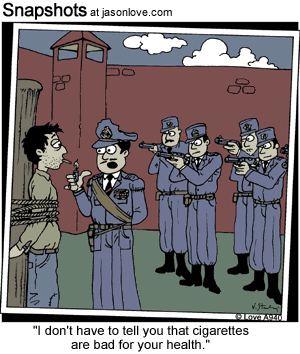
I read recently that Utah is trying to pass a law to once again make it legal to execute prisoners on death row by firing squad. Lawmakers in both the state's House and Senate passed the measure, and the only question is whether the Governor will sign it. 

Apparently the move was prompted by recent shortages of lethal injection drugs; lawmakers wanted to have a backup option in case they become completely unavailable. The more informed among them pointed out that it also has the potential to be much more humane, considering how nasty things can get when a lethal injection is botched.

Personally, I think the idea is an excellent one. Far from making them look "backwards and backwoods" as one opponent put it, it makes them look like a dying breed... people who understand both math and guns!

Even relatively expensive ammunition is pretty darn cheap.  Between the military and the police, there should be no shortage of individuals with the training to lethally shoot someone. (Given the nature of the people to be executed, I'd lay money you could get any number of those qualified individuals to volunteer for the job!)  If the person doesn't die instantly, you can instantly put another round into their brain and it's over. No drawn out suffering, no mess.

Lethal injection drugs are anything but cheap. They have to be ordered/shipped from Europe, handled and stored under strict guidelines, and administered by specialized staff. There is plenty of room for messy failure, complications, and suffering.

According to the original reporter (article linked above) "The Washington, D.C.-based Death Penalty Information Center, which opposes capital punishment, says a firing squad is not a foolproof execution method because the inmate could move or shooters could miss the heart, causing a slower, more painful death." (Personally, I'd like to ask if they actually understand how firing squads work, or if they've ever heard of "execution style".... the way firing squads will end up with anything other than fast death is if stupid and excessive regulations prevent second shots/head shot when they're called for.)

As a voter, I can tell you which one I'm behind - the one that's more efficient, more cost effective, and faster/cleaner for the person being executed. Whether or not there should be a death penalty is its own question. But for as long as it is legal in some states, let's demonstrate some common sense in carrying it out, shall we? 

Kudos to you Utah. I hope your Governor gets on board!