Monday, January 8

Word of the Day

I ran across an awesome word today: insalubrious.

in·sa·lu·bri·ous
/insəˈlo͞obrēəs
/
 adjective, formal: (especially of a climate or locality) not salubrious; unhealthy
  
I can't think of the last time I've seen this word in print or heard it used anywhere, but it's much too fabulous to be so neglected, don't you think?


  1.  

Sunday, January 7

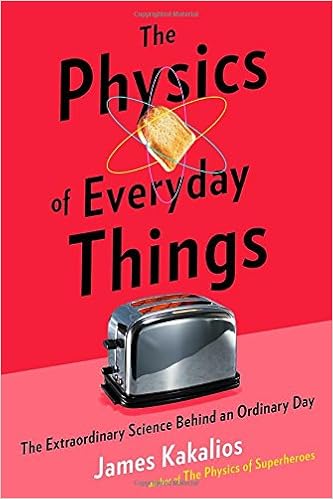
The Physics of Everyday Things

The Physics of Everyday Things is a brilliant book that made me feel, shall we say, less than brilliant. It is also a book I wish that I had had the opportunity to read at a much younger age. If you want to get kids interested in science and technology, this book (and Kakalios' other book, The Physics of Superheroes) is how to get started!

The framing of the book is magnificently done: we follow a normal, average businessman through his typical day, from waking up to going to bed, exploring the technology he uses and encounters along the way. This includes everything from the toaster that makes his breakfast to the GPS that helps him navigate traffic to the touchscreen of an ATM and the high-tech equipment he benefits from at a doctor's appointment, on an airplane flight, and in a business presentation. There's discussion of everything from simple electrical circuits and basic conduction to the binary language of computers, radio waves, and the mechanical back-up fail-safes that keep our elevators secure.

It was eye-opening to be reminded of just how much technology – both what we consider 'high-tech' and older-school but equally complex alternatives – goes into the modern life we so easily take for granted. Interesting as the book was, however, parts of it were hard for me to get through which I attribute to two factors. First, to be blunt, the science classes of my youth were clearly lacking. I have vague memories of talking about electrical circuits, magnetism, etc. round about fourth grade and occasionally in high school, but I decidedly did not retain enough to go into this book with anything qualifying as background. So I was fully reliant on the explanations in the book to keep up. Which would have been fine, except for factor number two: I am a visual learner. Although Kakalios provides very well done explanations, there are few diagrams, sketches or illustrations in the book and they are all exceptionally minimalistic. That's probably fine if you're keeping up, but I consistently found myself tempted to put the book down, hop online, and find a better one to catch me up before I kept going so that I could stay with the program. Now, if you're reading this with a young person, that's probably a point to the book's favor. If you're just reading it for your own edification, not so much.

But that's just me. Your mileage may vary, and the book is decidedly worth giving a shot!
Wednesday, January 3

Customer Quote of the Day

Customer, talking to my boss today at work: "So my friends made me go to this musical and, you know, there was music -..."

(That was when I stopped listening because, um, hello?! Musicals that have music in them? You don't say!)

Hope you got a free laugh somewhere in your day today, too. : )

Random Fun Fact About Allergies

From a book I recently finished:

"There are many foods that share similar compounds with common allergens. For instance, wheat and grass can both cause a kind of cross-reaction. So can, oddly enough, bananas and latex." (x)

Wheat and grass I get, but... bananas and latex?!?

In case you needed a reminder that the world is a weird, weird place... there you go.  : )

Tuesday, January 2

Happy Sci-Fi Day!

Happy New Year!
And Happy Sci-Fi Day!


May 2018 bring you new adventures (and the strength to meet them head-on) & new joys (and the wisdom to immerse yourself in them fully).

Thursday, December 28

How To Troll People Who Tell You Your Marriage Won't Last

This was beautiful and I just had to share because there are SO many people who simply refuse to believe it is possible to remain happily married. I can't tell you how many people I know in my generation who have taken (and continue to take!) a ridiculous amount of flak for being solidly, stably married and happy about it.

I tell my husband all the time that I wish I could brag on him more than I already do without it somehow making a big chunk of the other girls/women around me miserable or making them feel bad about themselves.

So I was extremely gratified to find this example of a high-profile couple (Sarah Michelle Gellar and Freddie Prince, Jr.) proudly holding their own in lock-step with the rest of us who realize that it IS possible and NOT something to apologize for or feel self-conscious about.

Are you happily married? Go kiss your spouse! And the next time someone bitches about how awful and patriarchically/femistly oppressive marriage is, etc., smile sweetly and troll them to their face by point out how long you've been making it work and loving it! 

(Original here, because I know the pic is hard to read.)

Wednesday, December 27

Historical Perspective

photo credit
I recently ran across this article online about "the booming Japanese rent-a-friend business."

Lots of people are kind of freaking out about it, which prompted me (again) to be a little sad about how we, as a culture, teach history. Paying people to play what we might otherwise think of as intimate roles in our lives is not a *new* phenomenon.

Keeping a courtesan in the court of a French or Engish king, something people did for centuries, was (at its base) just a fancy system of paying someone to be your girlfriend. Numerous cultures have positively ancient traditions of paying mourners to weep and wail in funeral processions, which is just paying someone to pretend to be your friend under another another name. Wealthy Victorians (and people of other eras, as well) routinely paid young women to travel with them as "companions," filling a role somewhere between that of a servant, a friend, and a dutiful (adult) child. On the slightly seedier side of things, "escort" services have long been a big business in many cities and, again, they're essentially just a set up where you can pay someone to be your date - aka to play your girlfriend/boyfriend so you don't have to go to a social event alone.

Certainly there's value in being realistic about humans' universal need for connection and regularly asking hard questions about places and trends where we find a breakdown of the 'natural' healthy family and social environment. But I can't help but think that, in relation/comparison to other historical trends, this is a pretty normal development. (Food preparation and consumption, for example, followed a similar trend - it began as something done within homes and relationships as a natural outgrowth of caring and traditional family structures, and evolved into the generic, anonymous, paid-for service industry it is now.)

It's a pity that we spend so many years in school and have so much free (at least right now) access to online resources of every description, and our pool of shared cultural and historical knowledge is still so shallow that people can't recognize the reincarnation of an age-old idea. Once again, I am grateful to have been blessed with parents who taught me to love reading from a young age, so that I got exposed to a diverse array of ideas and realities that I would otherwise never have encountered!