Friday, April 29

Holiday Reminder

Did you know that there are four holidays next week?

Tuesday is Teacher Appreciation Day.
Wednesday is Star Wars Day.
Friday is National Nurses Day.
Sunday is Mother's Day.

If you have any teachers or nurses in your life, take a moment to offer them so encouragement!
Then put on comfy clothes, pop up a generous batch of popcorn (with lots of butter and some sea salt!), grab the original Star Wars trilogy, and settle in for a marathon! 

PS - Want to plan ahead? 

May 21st is Armed Forces Day and May 25th if Geek Pride Day! Of course, Memorial Day is May 30th. 

What are you celebrating in May?

Friday, April 22

Syruping & The Hole Project

In theory, according to the calendar, it's been spring since March 20th. In practice, the weather has been all over the map thus far this year, which has made it hard to plan and anticipate outdoor responsibilities and projects. Despite the unpredictability, we've managed to have some happy successes

Exhibit A: Syruping


I'd pretty much decided by the end of March that we weren't going to get any maple syrup this year. Between the random spikes in temperature and prompt re-freezes, it looked like the trees were going to bud (and make the sap bitter) before we got the proper temperature spread we needed to get decent flow.

Fortunately, my husband is more optimistic than I am and realized that we had a second chance in the beginning/middle of this month. The temperatures fell into line, we threw taps and buckets on the trees, and spent two weeks boiling down sap. Voila! Maple syrup! We got an outsdoor burner in a different style this year which made a big difference, and I'm very pleased both that we got a generous amount of syrup and that we learned some new things that will be useful in the future about expanding our production.

Exhibit B: The Hole Project

This month, we had the pleasure of taking delivery of our very own tractor! My brilliant love did a ton of research in advance to identify what we needed and sort out the best option for our requirements. The end result is a shiny new Kubota BX tractor… well, it was shiny until we started using it! Now it's a bit on the muddy side, but I'm pretty sure that's a sign of love when it comes to utility vehicles like that, right?

We've got a number of projects lined up that the tractor will play an essential role in, of course, aside from the standard things like snow management every winter. One of our more pronounced projects underway at the moment is stump removal. We've been steadily taking down trees that were fall hazards to the house or that seriously impeded light to the house/garden areas of the yard since we moved in. Not surprisingly, this has resulted in a generous number of stumps hanging around that we'd like to also remove. If you've ever tried to dig a stump out by hand, however, you'll appreciate what a daunting, time-consuming, and often back-breaking process that can be. Compliments of the Kubota, it's getting a lot easier!

This is the current progress on an absolutely enormous and stubborn stump in the back yard. It's still too heavy/too solidly connected to rip out, but with a little more time digging it'll be gone, opening up valuable yard space for other things.

Spring/Summer weekends are going to be even more precious and packed than usual this year, but it's encouraging to finally feel like we're off to a really good start on all the things we hope to get done around the property.

Thursday, March 3

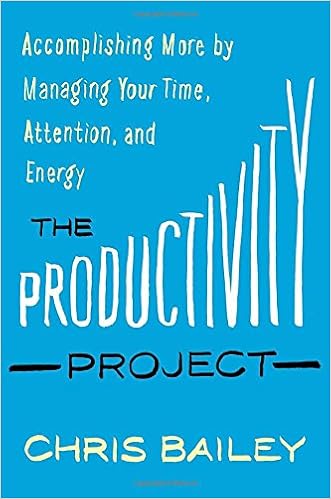
The Productivity Project

Everyone is busy, all the time – or at least so it seems, these days. As a result, maximizing productivity to make the most of our time is, not surprisingly, a huge source of public interest.

Openly obsessive about productivity, author and blogger Chris Bailey turned down several high-paying job offers to spend a year exploring and experimenting with the subject of productivity to find out what really works and what's just hype. Initially, he chronicled his experiences on his blog. When his year-long experiment ended, he culled the best and most valuable findings from his work and turned them into a book: The Productivity Project.

Clearly written by someone who values efficiency, the book walks a neat line, being fluidly easy to read while still concise and extremely well organized. Every chapter starts with an 'estimated reading time' and a clear statement of the key takeaway (which I loved), and ends with a short, highly relevant “exercise” to help readers implement what they've learned. Bailey strikes a valuable balance between research and personal experience, reminding readers that despite some universal truths (we each only get 24 hours a day) every person and situation is unique, so our individual solutions may be too.

I found myself constantly flagging pages to come back to and chew on again, and will definitely be rereading this and recommending it to others. Far and away my favorite part was the author's emphasis on the fact that all productivity improvements come down to manipulating one of three core components: time, attention, and energy. This simple but high-impact framework really (and positively) changed how I looked at a lot of things I've been doing and gave me valuable direction for future choices.

Monday, February 8

5 Fascinating and Thought-Provoking Links

Just what the title says... links I've found in the last couple months that made me happy or made me think.
Source

Steam-punking a back brace to look like cosplay armor. AKA why it is awesome to be a geek/have geeky friends. This definitely got me thinking about the intersection between creativity, the Maker Movement, and the eminently practical ways in which we love on people in everyday real-life situations.

Shut Up, I'm Amazing. A fantastic reminder that our internal voices matter. Serious food for thought on the reality that we have both the power and the responsibility to be intentional about how our words - spoken and unspoken - shape our lives.

What Color Lightsaber Would You Wield Quiz. I am delighted to report that (like my new hero Mara Jade) I got purple, which means I am unapologetically "more morally ambiguous" than your average Jedi. Or, as Mara puts it, "I fight exactly as fair as my opponents" and have an "undiminished capacity for mayhem."

How Do You Define Strong? "So what is strength? Well it depends on our sport, lifestyle, and goals."
This is a somewhat technically oriented article written by a strength trainer, but I really appreciated the message at it's bottom line (and written between the lines): arbitrary fitness standards, goals, and measurements are largely pointless. What matters is how you define strong for your personal body and life. If what you're doing or measuring doesn't serve to bring you closer to strong as you define it for yourself, give it up, throw it out, and replace it with something that does. 

How to Move (and Fly) A Body. "Because, well, we seldom die where it’s most convenient." A random and fascinating look at the kinds of realities and logistics that are surprisingly relevant and entirely predictable, yet rarely considered until the worst possible time.

Bonus link: The Fictitious Pregnancy of Mara Jade.
This is a short, hysterical non-cannon story from the Star Wars universe in the tradition of Oscar Wilde's The Importance of Being Earnest.  It isn't the best edited, or the best in-character portrayal of everyone, but it's so funny and well put together that it more than makes up for what it lacks.

Sunday, February 7

Happy [Belated] Clean Out Your Computer Day

I'm rather a fond of unofficial and off-beat holidays, and the ISTJ in me doubly appreciates when unofficial holidays serve highly functional purposes. Last Tuesday was a perfect example: National Clean Out Your Computer Day.

In this age of digital everything, it's all too easy for our computers, phones, and other devices to become cluttered with old and duplicate photos, ambiguously named files, defunct links and bookmarks, and other outdated remnants. Data storage being what it is, these things are easy to ignore on a day-to-day basis, but the sad truth is that they tend to cost us time and energy when we can least afford it. As anyone who's ever ransacked their hard drive for a critical file needed on short notice knows, clutter gets frustrating fast when you're in a hurry.

Interestingly, I was reminded several times in December by unrelated sources that the difference between businesses/households that thrive, succeed and function smoothly and those that don't can often be summed up in one word: systems.

Even exceptionally simple systems, when well designed and followed consistently, can radically reshape our lives for the better. It can take a couple tries to establish and refine systems that work for our unique needs, and the creation or reformation of habits is usually involved, but the relative payoff is huge.

I didn't get my computer (or my Pinterest account) completely cleaned out last week, and I admit I'm still actively working on establishing and revising systems for a variety of aspects of my life. I also have yet to address at all the whole necessity of properly backing up important files. But I did appreciate the reminder that this is an area worth focusing on, and the challenge to pick up my pace in this respect. After all, what better time to roll up one's sleeves and do a little digital purging an organizing than when it's cold and inhospitable outside?

What about you? Could your digital life and personal/professional systems use some refining this year?

Saturday, December 26

Book Review: Nonsense, The Power of Not Knowing

Ambiguity, uncertainty, lack of closure: whatever you want to call it, the world is rife with situations and challenges that simply can't be neatly categorized, wrapped up, or controlled. How we perceive, understand and respond to these types of situations plays a critical role in determining whether we succeed or fail in everything – art, business, politics, relationships. More often than we think, it can mean the difference between life and death. It's no secret that some people handle ambiguity better than others and, in Nonsense, author Jamie Holmes explores why that is, and what all of us can do to improve our relationship with life's uncertainties.

This book has a lot going for it. The author found some very interesting stories and examples to illustrate his points all along the spectrum, from puzzles and Mad Libs on the frivolous side of things to hostage negotiations at the extremely serious end of the spectrum. Often the writing was clear, sharp and fluid – very much a pleasure to read. It was meticulously edited.

Unfortunately, the book was not uniformly strong. In several places the narrative seemed to inexplicably get lost, meandering or segway-ing jerkily from one point to another. For some reason I never quite figured out, it also seemed to be a difficult book to keep one's head in. Every time I set it down, it would take a minute to remember where I was and what was being discussed when I picked it up again. It really didn't stick or linger the way I would have expected from a book about such a relevant subject. I couldn't help but feel that the “application” part would have decidedly benefited from a different approach as well; an alternate format might have made it easier to walk away feeling like I'd learned practical things I could effectively apply to improving my own ability to handle ambiguity other than just being more aware of it.

All things considered, it's a solid book and worth reading for the impact and thought-provoking qualities of it's strong portions. 

I received this book from the Blogging for Books program in exchange for this review. As always, my opinions are my own.

Monday, December 7

Common Core: Medical Edition


They say that measurement is the first step towards controlling and improving things, and that “you are what you measure”. Management dogma has long promoted intensive measurement, tracking and reporting as the main driver of desired change.

Unfortunately, as the Common Core debacle has demonstrated, any attempt to apply this theory to practice will see it quickly erode in the face of two inconvenient realities. First, critical and relevant aspects of a situation are often intangible; they simply don't lend themselves to effective and accurate measurement. Second, no matter what you're looking at, there are almost always scores of contributing and/or influential factors, making it almost impossible to measure, aggregate, and report on them in a meaningful way. Considering that some of those factors will be several steps removed from the “main action” and/or intangible, and you've got a clear recipe for frustration!

Why am I rambling at you about this business nonsense? Because it's exactly what came to mind when I read that “non-profit news outlet ProPublica [has created a] never-before-available tool” they're calling an "Adjusted Complication Rate." Long story short, they've developed and launched a scale ranking “Nearly 17,000 doctors performing low-risk, common elective procedures such as gallbladder removal and hip replacements... in the new calculation...derived from government records collected about Medicare patients...” The score looks at post-operative complications “like infections, clots or sepsis” and a handful of risk factors such as “patients' ages, the quality of the hospital where the surgery took place, and other factors.”

The goal is straightforward: provide consumers a tool through which to compare the quality of potential surgeons before scheduling a procedure, and create a highly public venue through which to shame, scare, or (more euphemistically) motivate both doctors and the hospitals for which they work to step up their games, sharpen their skills, and identify and remove roadblocks to top-notch patient care. As a bonus, proponents suggest that these changes will significantly reduce the cost of readmissions related to surgical complications. Considering that such readmissions for Medicare patients cost “taxpayers $645 million” between 2009 and 2013, this is no small benefit.

ProPublica's intentions are clearly noble, and they should be applauded for doing something. After all, you never get anywhere if you don't at least try! That said, I can't help but cringe at what looks alarmingly like the early stages of a repeat of the Common Core disaster in the making. They're right to note that not all doctors or hospitals are created or perform equally. Certainly those doing well should be rewarded, and those at the bottom of the barrel strongly motivated to improve.

But the inconvenient truth is that people are bio-individual, both physically and in terms of their physical, social and familial support systems. For example, as an NTP I can tell you that most people are walking around with all kinds of undiagnosed and unrecognized health issues that are directly relevant to their ability to heal and their likelihood of readmission. My sister the nurse can testify to the kinds of disastrous individuals and relationships patients often rely on for their post-procedure care. These things are not, and cannot consistently or realistically be, accounted for on this index. As a result, just like teachers, doctors will be penalized for things outside their control without recourse to explain or defend themselves. Doctors battling to revamp struggling hospitals, or serving the lowest-income, most at-risk patients will suffer the most in this respect, punished for their faith, elbow grease, and big hearts.

Many doctors will respond by taking the only protective course available to them: refusing to see or work with any patients who don't present as excellent candidates for a quick, clean recovery. Dealing with a messy family situation? Obese? Smoker? Low-income? Cantankerous or absent-minded? Watch how fast you get turned down and punted over to the waiting list for one of the handful of (low ranked) doctors still willing to take you! As it stands, this well-intentioned ranking will most likely have the unintended (if predictable) effect of making losers out of neediest, least-ideal, and highest-risk among the us and those who stubbornly continue to serve them.

I can't help but be deeply saddened to see this kind of thing happening. We need real answers; real initiatives that get at the heart of the problem (like the increasing loss of non-profit hospitals), rather than relying on false metrics and sideways pressure.


What do you think? Am I over-reacting, or does this strike you as terribly counter-productive, too?