Monday, November 2

Hack Schooling Resources #1

It occurred to me after I wrote my previous post on my hack-schooling endeavor that it could be enlightening to track what resources I use here on the blog. Not only might introduce others to valuable resources, but it should be personally edifying and useful long term to be able to look back and survey what worked, what didn't, and where I might have some blind spots in my pursuit of learning.

So here are a few resources that have already earned their keep in this adventure:

1. Amazon's Kindle Unlimited – For $10 a month, I get as many books as I can read. They are instantly downloadable and returnable at the push of a button at any hour of day or night, from wherever I am, and I can have up to 11 out at one time. This was a God-send when I was working on my TEDx talk all summer, and I've found that many of the blogging-related books I was interested in that the library didn't have were available free through this service.

2. Sticky Notes & Good Pens– Happily, everybody took me seriously last Christmas when I told them what I really wanted was nice pens. I got a bunch of Le Pens, and they make me unreasonably happy. Paired with a giant stack o' sticky notes in various sizes and colors, they are essential to keeping my studying and notes organized.

3. White Board Clings – I don't know anyone else who has or uses these, but I highly recommend them. They're peel-and-stick, and thus far appear to be endlessly reusable. They come in a variety of sizes, and are quite durable. They're inexpensive, don't crack, easy to transport, and can be combined (lined up edge to edge) to make a larger white board in any shape you want. What's not to like?

4. Library Card – Yes, this one should probably go without saying. But in this day and age, it's worth reminding people that there's huge value in getting to be on a first name basis with your librarians and figuring out how to navigate your library's online system.

5. Simple Rules – I got a copy of this book free to review, and was surprised by not only how good but how applicable it was. I knew that research proves that working within constraints forces people to be more creative and to work harder at identifying what's really important, but this book uniquely applied that principle to how a business is run. (Though it can be equally applicable to homes, families, and all manner of other situations.)

That's it for now! Hope someday something on this list serves you well, too!

Saturday, October 31

Books on Death for Your Halloween Reading Pleasure

Happy Halloween!  

I don't read a lot of proper ghost stories or other traditional Halloween fare, so I thought I'd take advantage of today's holiday to share instead three of the best books I've read related to death. If you can't get enough of the creepy, spooky, cryptic Halloween vibe, consider these a great way to extend your exposure to all things postmortem. If you're not a Halloween fan, turn off the lights, lock the door, and grab one of these to curl up with as you avoid the trick-or-treaters and other chaos tonight. They're well written, eye-opening, and fascinating - no matter when you read them!

The Smoke Gets in Your Eyes by Caitlyn Doughty
Now a licensed mortician, Doughty shares her first experiences working in the funeral industry at a crematorium. Full of fascinating stories, helpful information, and insightful reflections on attitudes towards death in America (and how they got to be what they are), this is a must read. Note: Doughty also runs a fantastic "Ask a Mortician" web series, which tackles very real and meaningful questions like why its illegal to have a viking-style funeral (you know, where they shove your body out into a lake in a burning boat) and whether or not coffins can explode (they can).  

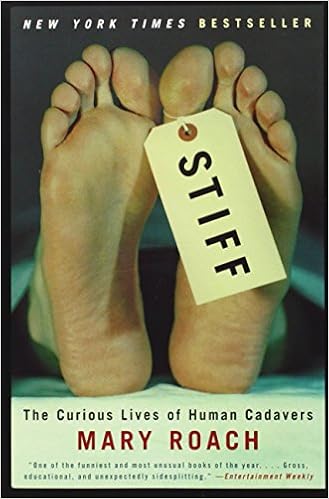
Stiff: The Curious Lives of Human Cadavers by Mary Roach
If you've ever looked at the back of your license and wondered what exactly you're agreeing to when you donate your body to science, this is the book for you. From medical school uses to crash test dummies, Roach gives readers a broad view of the many ways society (quietly) uses cadavers every day for a vast array of purposes. The tone is cheerful and the subject well handled, making this a good and worthwhile read. 

Death's Acre: Inside the Legendary Forensic Lab the Body Farm Where the Dead Do Tell Tales by William Bass
This one is for everyone who has ever watched and loved CSI, NCIS, Bones, or any other forensics show! All that great information those forensics geniuses have about how long it takes for processes to happen, what order bugs infest a corpse in, what happens when a body is sunk in a river/frozen/left in a trunk... well, you get the idea... all that info comes from Bass and his body farm! The book tells the story of a "farm" on which bodies (legally donated to science, mind you) are intentionally placed in every conceivable position and environment, and then tracked while they decompose. The information is meticulously gathered, recorded, and translated into the timelines, chemical signatures, and other foundational information on which so much of modern forensics is based. 


None of these books are particularly new, so your library should have them. (They're also available via Kindle if you prefer.) Enjoy!

Thursday, October 29

Design the Life You Love (A Book Review)

A friend recently introduced me to Blogging for Books, and I thought I'd give it a try. The first book
that caught my eye was Design the Life You Love: A Step By Step Guide to Building A Meaningful Future.

The first thing that stood out to me was the book's design; the cover and the pages are clean, uncluttered, and very much oriented towards visual/kinesthetic learners. There are prompts for writing, brainstorming, mind-mapping, sketching, and other interactive activities to help readers process and apply what they're learning. I thought this was ideal for this kind of book, because it forces you to go slow and really absorb and think about the material – not just blow through it.

The author effectively used metaphors and examples to help her points across, encouraged readers to only focus on a few things/changes at a time to prevent them from getting overwhelmed, and included a variety of helpful templates (mind map, manifesto, to-do lists, vision letters, poems, etc.).

While I did not work straight through the book start to finish, or use all of the tools, the book and its approach definitely prompted me to think deeply and creatively about how I'm living, what I love, and what kind of changes I could make to live better. Some people have books they re-read every year; I think this would be a great book to keep on your shelf and pull down every year on your birthday and around Christmas/New Years as a reminder to pay attention to where you are, and who/where you want to be. 

Disclaimer: I received this book from the Blogging for Books program in exchange for this review, but (as always) all opinions are my own, honest and unbiased. 

Thursday, October 22

Salmon & Salad with Dijon Dressing

For a very long time, I didn't eat salmon. I blame this entirely on my food service career. Fish is hard to do - and particularly hard to do well - in the catering, commercial, and industrial food service venues in which I was primarily exposed to it. Food safety regulations require that you cook it to death to begin with. Let it sit at all, on a buffet or plated while other meals are finished, and it gets even worse. I still won't eat the stuff cold. (Blegh!) 

Clearly not my photo, but appropriate.
It's pretty much impossible to get decent fish out here anyway, so for years it was just off the table altogether. But a few times we miraculously got our hands on some decent fillets of salmon, and my Prince grilled them for us. And that was eye opening. Under his skilled hands, it was suddenly flakey and buttery and divine.

While we still have a hard time sourcing salmon, I've been inspired by that grilled loveliness to learn how to cook salmon on the stove or in the oven. It's still a work in progress, but we recently tried this delectable (and stupidly simple) recipe and loved it. I wanted to share. 

This is from the Thrive Market cookbook, attributed to JJ Virgin.  It took far less time to toss together than advertised, and is a new favorite.

Pan-Seared Salmon Over Tri-Colored Salad with Dijon Dressing*

Salad
2 teaspoons lemon juice
1 tablespoon finely chopped shallots**
2 teaspoons Dijon mustard
1/8 teaspoon sea salt
1/8 teaspoon freshly ground
black pepper
4 teaspoons extra virgin olive oil
1/2 small head radicchio, thinly
sliced, about 2 cups
1 Belgian endive, thinly sliced,
about 1 cup
3 cups baby arugula
 
Salmon
1 teaspoon extra virgin olive oil***
2 6-ounce wild salmon fillets, such as King or Sockeye
1/8 teaspoon sea salt
1/8 teaspoon freshly ground pepper

Combine the lemon juice, shallots, mustard, salt, and pepper in a small bowl. Slowly whisk in the oil until well combined and set aside. 

In a separate bowl, combine the radicchio, endive, and arugula; set aside.
 
Heat the oil in a small nonstick skillet over medium heat.
 
Sprinkle salmon with salt and pepper and place in skillet, flesh side down; cook, until fish flakes easily with a fork, 4-5 minutes per side. Remove from skillet.
 
Toss the dressing with the lettuces and place on the two plates; top each with a salmon fillet.

*   Sub any type of greens or salad mix you like or have on hand.
**  I used regular onions, eyeballed them at well over this amount, and it was still excellent.
*** I subbed butter. (Yes, I know, I do that a lot.)

Wednesday, October 21

Hack Schooling

I think I first heard the term "hack schooling" a couple years ago when I listened to this TED talk. Generally speaking, I'm not a huge fan of the term "hack". I appreciate that for many people it has positive connotations, but it rarely works for me. In this particular case, however, I feel as if the term is the best one for what I'm doing: hack schooling myself on how to blog professionally and how to be a "solo-preneur" (another new word I wasn't initially sure I liked).


When I got my business degree a dozen years ago, the focus was on how traditional and formal businesses were run. The assumption was that most business majors would go work for Hilton or Disney or some other staid, high-end, highly professional employer. We practiced resumes, cover letters, business casual dressing, and other now-largely-obsolete aspects of corporate life ad nauseum. I'm deeply thankful for the deeply applicable background and skills I got in marketing, economics, product design/development, communication and basic accounting. I'm equally aware of just how little time we spent on many of skills I need now  like basic html manipulation, process development, and branding/materials design.

My Nutritional Therapy degree legitimately gave me everything I needed to get started, but there are so many ways to structure and run a career as an NTP that they simply couldn't dig very far into most of the behind-the-scenes mechanics. NTPs and other professionals have put together a variety of courses designed to cover these aspects, but I just can't see myself dropping $2,000 on something like that. Not when I have a business degree and a huge chunk of what would be covered is stuff I already know.

So I've decided to "hack school" myself, pulling together my own curriculum using a wide variety of free resources - books, articles, other bloggers' and professionals' tips and lessons learned, TED talks, tutorials... you get the idea! I've long believed in the power of self-education, and respected the fact that many of the most inspiring people in history - from the Founding Fathers to modern day entrepreneurs like Richard Branson - were largely or entirely self taught. I have spent enough time working alongside the higher education system (through food service and grant writing) to appreciate that I won't find what I need there anyway. With winter rapidly setting in, and the days getting shorter, it seems as if there's no better time to dig into studying.

I've already got a list of tools and resources lined up to start learning from, and a sweet friend sent me two of her top recommended books to explore. I'm staying open to other ideas as well, though, so tell me - what has touched you or blown your mind that you'd suggest I add to my list?


Tuesday, October 20

Mid-October Musings

I didn't realize that the official ides of October have come and gone until this morning. I've been elbow deep in projects as of late, and have done a terrible job of tracking time. But rather than focus on what I haven't done or been paying attention to, I thought I'd take a minute to celebrate the good things that have been filling my radar the last couple weeks.
  • Enjoying the Glorious Colors of Fall. That photo above/right is not our property (because I suck at photography), but it may as well be - it is abundantly gorgeous here. For all the stupid laws and ungodly taxes, I am blessed every day to live in the kind of place that most people have to try to vacation to.

  • Bedding Down the Garden. For the first time in my life, I actually got a garden properly bedded down at the end of the growing season! We ripped out the bedraggled remains of our tomato plants and pumpkin vines, tilled up the soil, then layered down compost, cardboard, and dried leaves. It was definitely a learning experience and I'll be more prepared next year, but I'm delighted to have done it (after years of thinking about it and not following through).

  • Planting tulip and daffodil bulbs. We planted a handful a couple years ago, but the spot we tried turned out not to be a good one; most didn't reappear this year, and none bloomed. So I grabbed a few packages from Lowes in September, and made time this past week to get them in the ground. I tried three new locations in the yard. Hopefully at least one will prove ideal for them, and I can get more and expand them next year. Spring comes late here, and I'm always more than eager for color, so I would love to eventually have a mass of lovely spring flowers.
  •  Shifting schedules and routines. I think I shared the Maker Schedule vs. Manager Schedule concept on here before. It is something I've been thinking about and playing with since I left grant writing, but what it looks like on a week-to-week basis has continued to change. Over the summer, fresh produce and house projects took precedence in my schedule. With the days turning colder and darker, and the menu leaning away from all-fresh-all-the-time, indoor and business projects have started to predominate. I feel as if I get a little more insight each week into how to make various actions, routines, and setups work for me, but every day still feels like a work in progress in some ways. 

  • Prepping for winter. Winter isn't my favorite season, but I try to enjoy the process of preparing for the change of seasons. Pulling out the rug for the living room floor, scouring the closets for where I randomly put the last few insulated winter curtains, and rotating quilts - it's a good exercise in gratitude and awareness as long as I don't let myself get stressed about the cold to come and everything I thought I'd get done in the summer and Fall but haven't! We had our first snow this past weekend, and that very much brought the reality of the coming winter home!
What are you enjoying this month?

Monday, October 12

Gretchen Rubin's “Power Hour” Re-imagined

I've discovered through trial and error that I much prefer reading Modern Mrs. Darcy talk about MMD explained how she'd re-imagined Rubin's weekly “Power Hour”.
Gretchen Rubin's work to actually reading it myself. One such post from last month really tickled my brain;

Rubin regularly designates an hour to knock out “tasks that are important but not urgent”. Those random things that pile up and can take literally months (or even years!) to do because we don't want to deal with the hassle and keeping finding reasons to put them off, even though we'd be much better off with them completed. Rubin used the example of taking clothing to be donated to a drop-off center. It doesn't actually take that long, and we're much better off without the clutter, but the energy investment of engaging with people and making time to veer off our usual routines can make it feel like a much bigger deal than it is.

MMD considered that idea, then adapted it to her current life situation – and I love the result! Instead of being overwhelmed with random small tasks cluttering her plate, she found that her biggest challenge was making time for larger tasks or projects related to things she wanted to learn/master but found it hard to carve out time for amidst a busy schedule. So she decided to try scheduling herself a Power Hour each week dedicated to pursuing a skill she wanted to learn.

That approach really got me thinking. If you dedicated one hour per week to something, by the end of the year you'd have invested 52 hours in learning and practicing it. As Josh Kaufman points out in his awesome TED talk, it may take 10,000 hours of deliberate practice to become a world-class Master of any given subject, but you can get more than functionally adept at something in as little as 20 hours!

Since functional adeptness is all most of us are shooting for in most areas anyway, in one dedicated hour a week is more than enough to add two new skills to your repertoire! As someone who has a lot of fascinating things I'd like to get into, that's an incredibly promising thought! I haven't settled on which skills exactly I want to focus on yet, but I'm determined to make up my mind and start experimenting with the re-envisioned Power Hour plan in November.

Would you consider adding this type of Power Hour to your schedule? If so, what would you like to learn?